

It’s summertime, and the livin’ is easy. The marketing though? Well, that never takes a vacation.
Over the past couple of months, my team at Brafton has been busy creating content, adjusting campaigns and ideating new initiatives. We’re a small but powerful team, and one of our strengths is our technology; not just that we have it, but also that we use it thoughtfully and strategically.
To us, contentmarketing.ai is more than a content creation companion; it’s our own product, built in-house intentionally and specifically for marketing purposes. No other AI tool on the market was created with such close collaboration with actual end users; that’s part of what makes it special to us, and powerful for the marketers who choose it for their own operations.
What does that look like in practice? Here are three projects my team and I carried out using contentmarketing.ai over the past few months:
Subscribe to
The Content Marketer
Get weekly insights, advice and opinions about all things digital marketing.
Thank you for subscribing to The Content Marketer!
1. Transform a Lunch & Learn Session into an SME-led Blog
I love a good Lunch & Learn session. At Brafton, we’ve been making an effort to have regular Lunch & Learns from our department leaders, and I feel we’ve all learned a lot along the way.
The best part of Lunch & Learns (from a marketing perspective) is all the marketing collateral you can create from them.
For example, did you see Brafton’s AI visibility webinar? Know how it started? As a Lunch & Learn!
A recent session from our CTO Stewart Snow was especially informative, because he broke down common AI myths that a lot of marketers have. As he spoke, I knew the information he was sharing was relevant to our audience, too.
As soon as he wrapped up, I knew exactly what I needed to do: Capture Stewart’s knowledge in an SME blog post.
I started with the transcript. I used to spend a lot of time cleaning up transcripts before feeding them into AI, because messy notes and misheard words used to be a lot more common and a lot more impactful on the output. More recently, I’ve found that a lot of models do fine with messy transcripts, as long as it’s mostly legible.
Using contentmarketing.ai’s Custom Content workflow (one of my faves), I gave it the transcript and asked for an article breaking down the concepts Stewart walked through. I also asked it to include some authoritative quotes from the session to support the content.
Once I had my draft, I shared it with Stewart so he could review the way his ideas were represented. The verdict: Two thumbs up, and a new SME-led article for the Brafton Blog.
Check it out here: AI Myths, Debunked: What Our CTO Taught Us About LLMs, GEO and SEO
2. Social Copywriting for an Awesome Blog Post
Anytime you have a great article on your blog, you must share it with your audience. Ideally, you do so through multiple channels. At Brafton, every blog post is shared, at a minimum, through our newsletter every Tuesday (subscribe to The Content Marketer here) and via our social media channels.
The thing about sharing on social media is that it requires social copy. This is something I know how to do, but the truth is, it’s not my favorite type of writing. As you might have gleaned from this article by now, I’m a long-form writer. Short-form is hard!
And when I’m in a time crunch but I want to share something on social media now, that added urgency doesn’t help me draft good social copy in the least bit. Luckily, I have contentmarketing.ai on my side.
When Chad Hetherington turned in his article, Top 8 AI Skills In 2026 & Beyond: How To Become a More AI-Fluent Marketer, I knew it had the exact type of advice marketers are looking for right now. I wanted to share it on social media right away; this list of 8 AI skills is too important to wait!
I told contentmarketing.ai exactly what I wanted right from the homescreen conversation bubble.
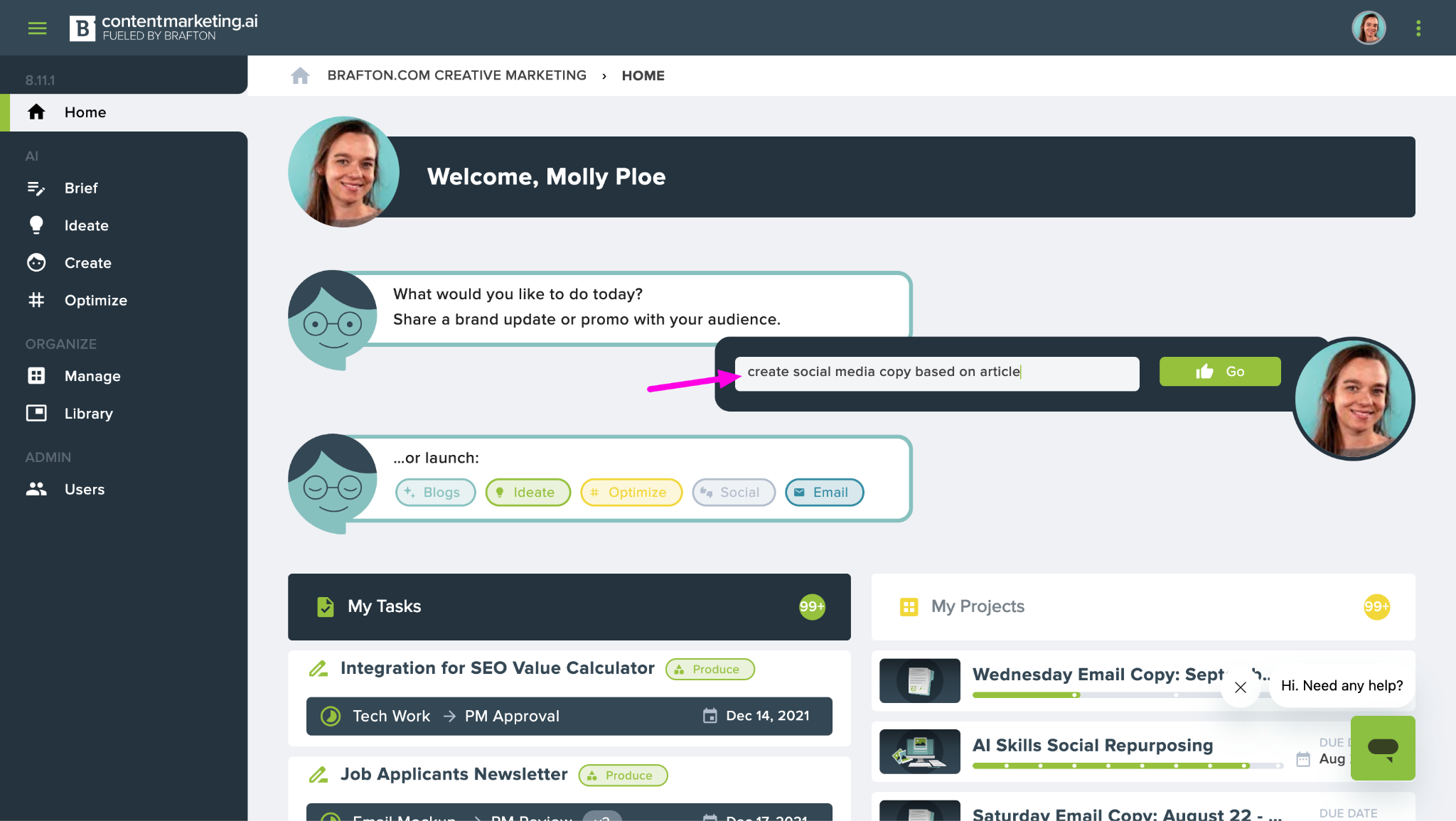
It launched the project right away, confirming target audience and writer briefs along the way. Since I was doing this before we published the article, I just copy-pasted the article text directly into the workflow.
It gave me 5 options of varying length, and all decent copy. I liked what I saw, but wanted another batch to choose from. I asked for 5 more options, and it delivered equally good options.
At that stage, I had 10 posts to choose from. I made my selections, did some slight copy-editing, and shared them with our social media team so they could schedule them ASAP.
3. Content Scoring & Re-optimization for Brafton Blog Articles
On the Brafton Blog, we’ve been publishing SEO articles for over a decade now. In time, all content ages. When that happens, one of the biggest favors you can do for Future You is to re-optimize it so it continues to perform well in organic search.
We’ve been re-optimizing blog content for about five years. When we first started doing this, it was a manual process that looked very similar to the manual SPB creation process for net-new content.
(SPBs are Brafton’s Search Performance Briefs, which we create for all SEO content we make for our brand and clients.)
As Stewart and his team began building contentmarketing.ai, some of the first tests we did involved automating the re-optimization workflow. It was a good baseline test to see how the platform would handle a familiar task.
Since then, the platform has become much more advanced and the types of content it creates are more varied. But we haven’t left our re-optimization process behind; in fact, it’s even more important now with the amplification of AI search platforms.
Those initial tests years ago were fairly basic: We gave the tool our target keyword, the URL and a keyword brief from MarketMuse. After the platform ran updates, we fed it back into MarketMuse to get an SEO score for the updated content.
I won’t lie: It was a clunky process that did require significant editing to the output. Plus, adding the extra MarketMuse steps just made it longer than it needed to be.
Today, our re-optimization process is much more robust, and is carried out entirely within the platform. Here’s how it typically goes:
1. We identify an under-performing blog post.
2. We give contentmarketing.ai the target keyword and the URL.
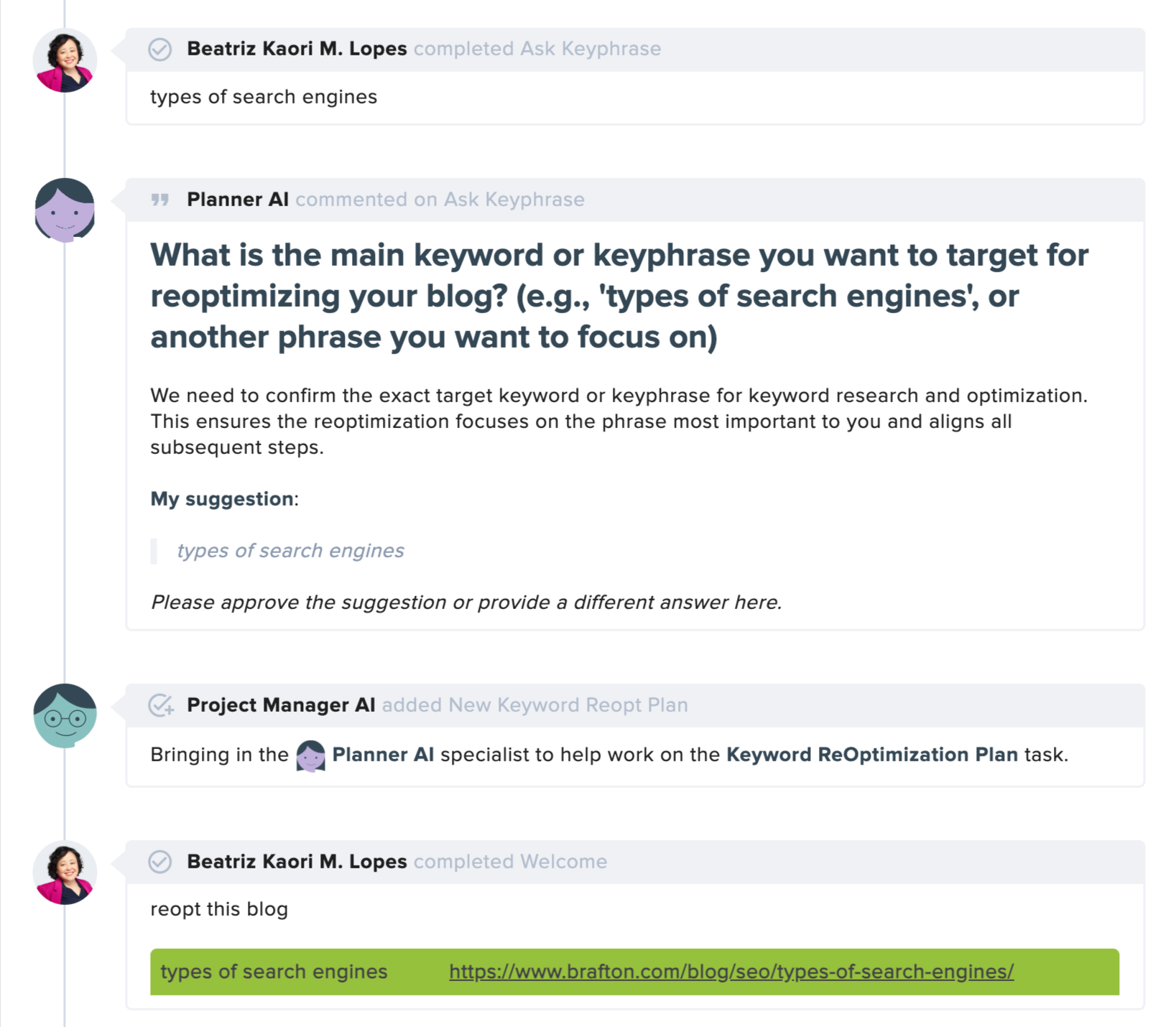
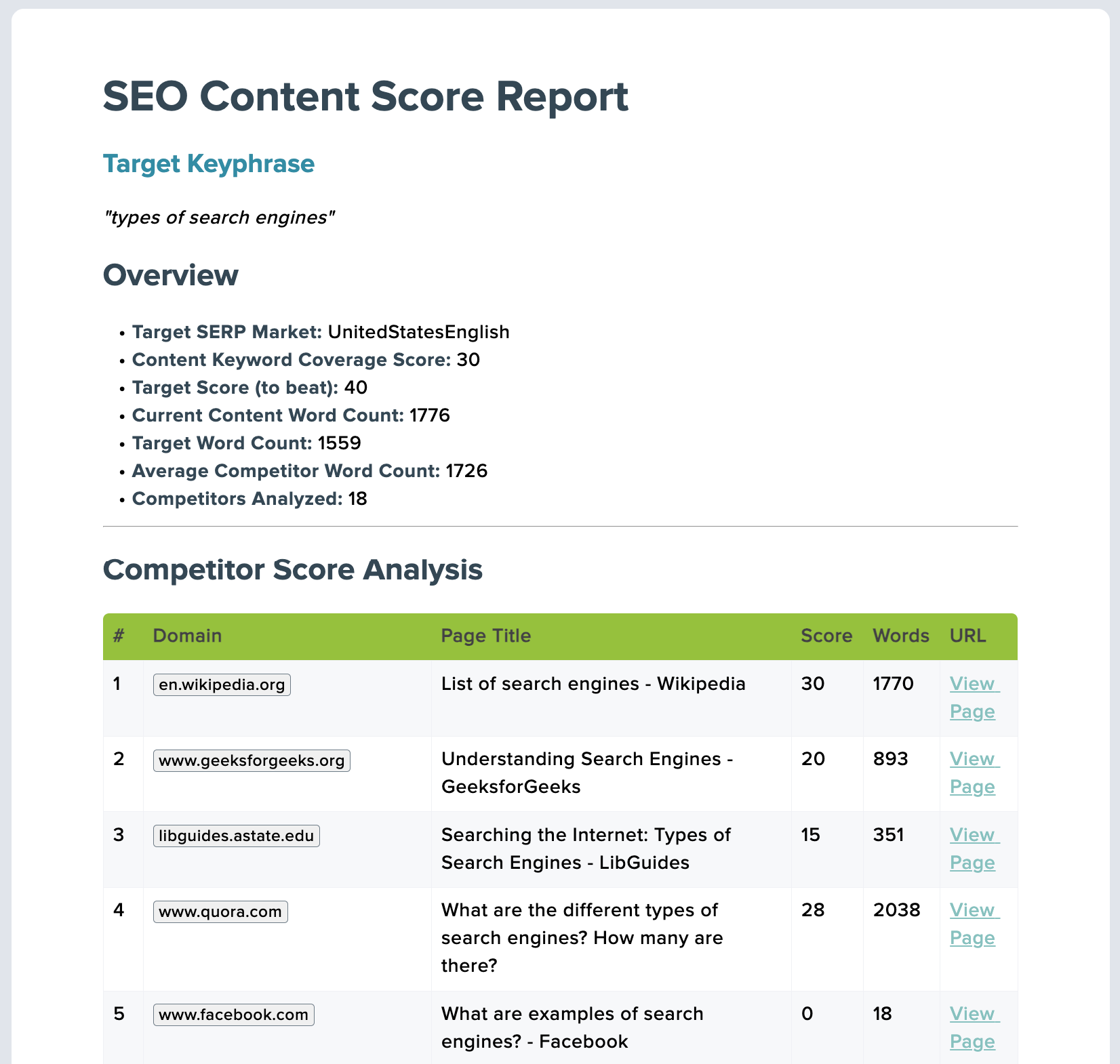
3. It creates a keyword brief and scores the content.
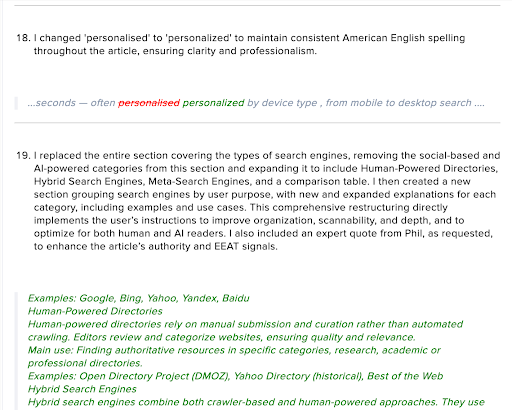
4. It recommends updates to strengthen E-E-A-T signals, including structural changes, additional topics and related key phrases to include.
5. It makes the updates to the article, staying aligned with our brand guidelines and writing style.
6. It re-scores the updated content and gives us a report.
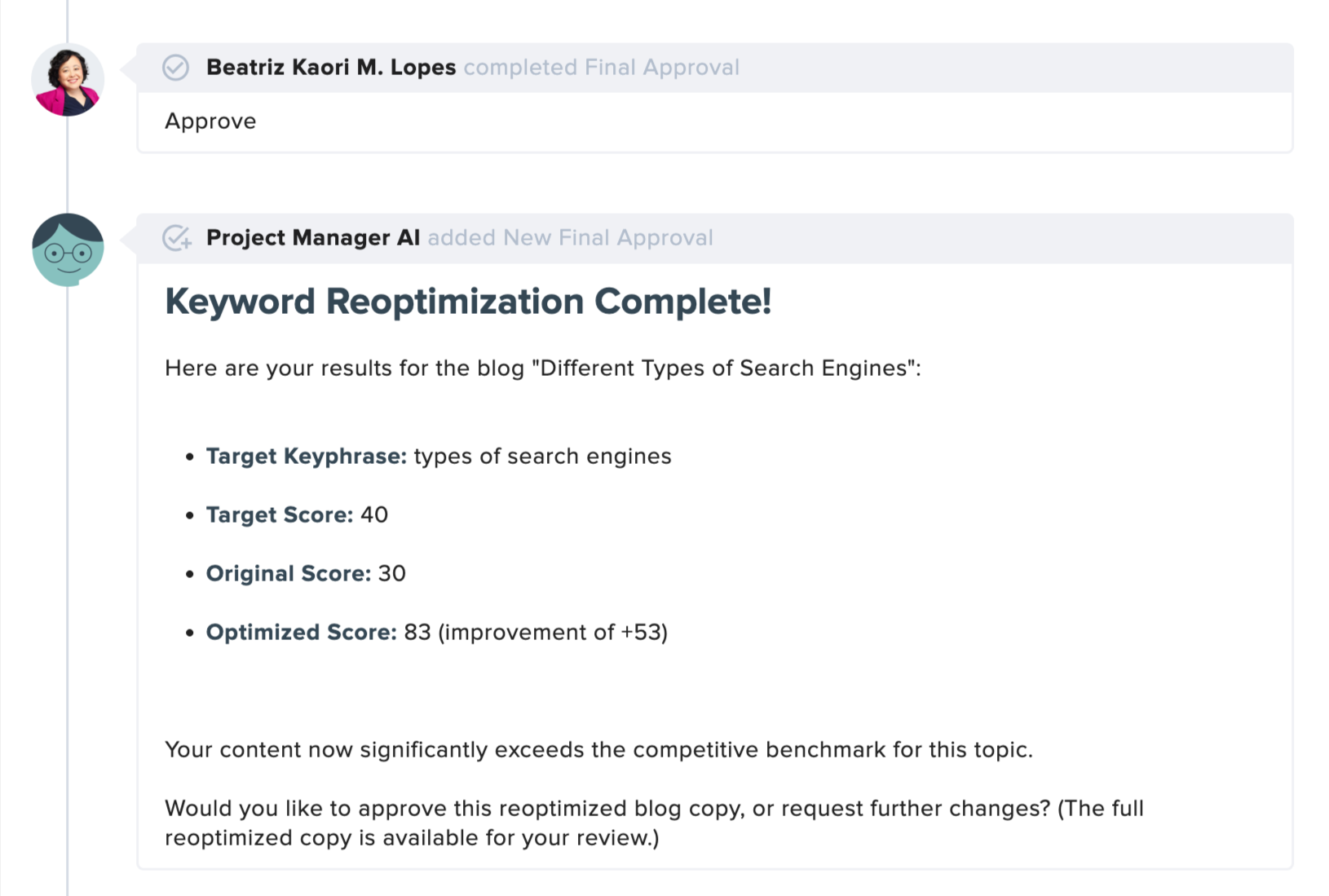
7. At that point, we do human review of the copy, sometimes making small adjustments here and there. But, I will say from my own experience, as well as feedback from our editorial team (who most commonly does this step), there’s minimal editing needed at this stage.
8. Finally, we update the article.
Want to see the outcome? Here’s the updated article from the screenshots above: Different Types of Search Engines
New elements like the quote from our AVP of SEO, Phil Weafer, and a structured comparison table are examples of GEO-type updates the platform optimizes for.
Slaying Summer Campaigns With the Help of AI
In February, I wrote that it’s wintertime marketing that tends to feel so busy. But six months on, let me revise my statement: There’s something about summertime marketing that’s persistently expeditious — maybe it’s all the sunshine. 🌞
By keeping contentmarketing.ai in my back pocket (actually, it’s a bookmark in my browser), I was never more than a couple clicks away from quick, high-quality content. And hey: That can be you, too! If you want an always-on content creation companion, just let us know you’d like a demo. We’ll get you set up with a 5-day free trial so you can see for yourself.
Note: This article was originally published on contentmarketing.ai.