

These days, a web copywriter can mean one of two things: A person who writes copy for the web, or a robot that does the same. We’re here to talk about both.
Now that the tools are readily available, it’s rare to find content marketing workflows that exclude generative AI. In fact, only one in five content creators doesn’t use it as a core part of their process.
Naturally, this raises a question: where do we draw the line between human and machine? The goal of this guide is to define where a writer’s craft yields to AI — and where it absolutely should not.
What a Web Copywriter Is (Human Version)
A web copywriter is traditionally a human who writes copy across multiple formats, consistently maintaining brand voice and building authority in their niche. To achieve this, they apply a set of technical and soft skills:
Optimizing for SEO and GEO
GEO and SEO optimization are technical skills embedded in marketing content writing. They involve keyword optimization, addressing search intent, formatting for scannability and extractability and clear communication. Writers optimize copy so crawlers can understand, index and extract it, enhancing visibility on traditional and AI search platforms.
Writing Compelling Copy
Writers must engage their ideal clients. In the attention economy, you’ve got seconds to state your case. To actualize compelling copy, writers need to:
- Deeply understand what they’re writing about.
- Know their audience.
- Synthesize information about products and services in niche verticals and convey it in a way that meets audiences where they’re at.
Information synthesis requires a higher cognitive load on writers, which AI can easily achieve faster than humans. Addressing search intent and reaching audiences with human-centric messaging is not so easily replaced.
Subscribe to
The Content Marketer
Get weekly insights, advice and opinions about all things digital marketing.
Thank you for subscribing to The Content Marketer!
Defining Brand Messaging
If AI is formulating your brand’s voice, you’ll be about as distinctive as a coconut palm in Malaysia. You could think about brand voice and messaging as the commercial equity you hold inside your customers’ minds: only a human can speak to humanity.
Creating Landing Page Copy That Converts
Persuasion is another critical skill writers should develop. Abstract thought, logic and critical reasoning make a message resonate, but authentic delivery is what drives it home.
Versatility
Writers produce copy in varying formats, for distinct brands and audiences, day after day. Few writers have the luxury to sit down and think about a project for a couple of hours before the starting gun sounds. They must be ready to rock and roll as soon as the next project lands.
Research Skills
Researching is the process of finding information and context you don’t have. This usually revolves around what you know you don’t know (e.g., stats, audience needs, etc.). A good copywriter is skilled in exploring what they don’t know they don’t know, making the copy nuanced enough to meet audience needs.
Efficiency and Being Thorough
Writers need to be efficient and thorough, producing brand-aligned content that ushers audiences toward a conversion.
AI Workflow Design
While it’s not exactly in the “technical writing skills” school, a writer’s ability to use AI to deliver value within marketing workflows is also a compelling trait.
Where Human Writing Falls Short
Some of these skills can be replaced, or at least enhanced, by AI. The two that can’t are scalability and accuracy. I once managed a writer who could produce twice the volume of copy as others in his team, and at a higher quality. I have an inkling he was using AI to get there, but he was also smashing targets on all fronts and to an excellent level.
Some writers are faster than others, but even efficient writers struggle to keep up with the pace of digital marketing since AI hit the scene. On top of that, often, the faster you go, the more room there is for mistakes. AI web copywriters help humans scale the volume and accuracy of their work — but the makings of a great writer remain 100% human.
What a Web Copywriter Is (AI Version)
An AI web copywriter is a generative AI tool that creates content across multiple formats in seconds, contributing efficiency and scalability to content workflows. A human’s role in website copywriting is increasingly to plug AI’s most notorious gaps. But AI can plug the gaps of humans, too:
- Automation: Whether it’s planning, writing, editing or keyword research, AI can automate virtually any part of the content creation lifecycle.
- Scalable content strategies: Scale is a natural byproduct of automation and productivity.
- Accuracy (within limits): You’ll virtually never find spelling or grammatical errors in AI copywriting. Gaps do show up in data, logical reasoning and audience understanding, to name a few.
- Versatility: AI can create across formats and platforms faster than a human can. Considering the need for persuasion, brand messaging and the human touch that actually converts, AI does not achieve this “better” than a human.
Note: You’ll notice that the human writer list is more comprehensive than its AI counterpart. That’s because the quality of your content ultimately comes down to the judgment, discernment and skill of the writer owning the project. Yet, just because someone is human doesn’t make them a skilled writer. For good copy, those are the boxes you want checked first.
Where AI Typically Falls Short
AI is excellent at shifting tone, audience focus and brand messaging. However, when producing content that meets the hypernuanced and hypersensitive human brain, even excellence is not enough.
Without compelling, authentic human delivery and consistently clear brand voice, people will not connect with the deeper messages underlying your marketing materials. Then, there’s the question of accuracy. Think about it: if both AI and I told you that just last month, China surpassed U.S. records by sending a submarine to the bottom of the Mariana Trench, who would you believe, and why?
How AI Is Changing What’s Expected of a Web Copywriter
The lines between human and machine are beginning to define themselves, so let’s explore what’s reasonable to expect of human copywriters and AI involvement. For a start, writers should be consistently producing higher-quality, more in-depth copy than they did pre-AI.
Automation has led to expectations that writers will create website copy faster, but that’s not always the case. In my experience, AI makes blog writing more thorough when used well — especially when it comes to outlining, search engine optimization, proofreading and formulaic tasks (metas, image alts, social media posts en masse, etc.) — but consistently faster?
Faster is not always better. Higher quality work within a reasonable timeframe is. Obviously, producing an excellent article over the course of a week won’t do nowadays, either. So, here’s how I see it:
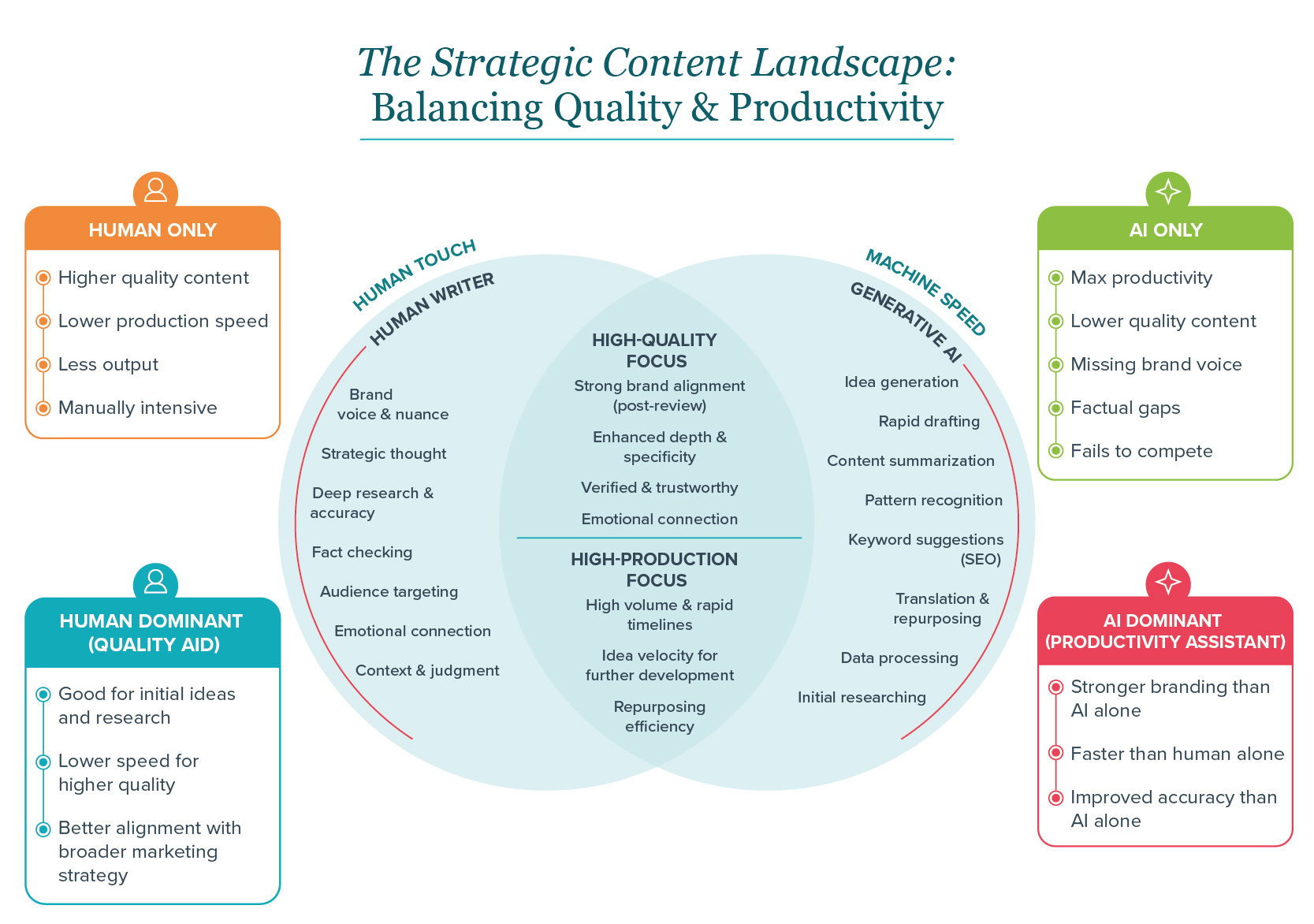
Human writers add the human touch. AI adds efficiency. How a writer balances their input with tools throughout their workflow determines the outcomes of the web content. Even when humans and AI collaborate, AI dominance will likely lead to quality, branding and audience engagement issues, whereas human dominance will likely lead to productivity issues.
The key here is to determine the right balance between AI and human — and that’ll change depending on the writer and the project. Learning to find an equilibrium that compensates for a writer’s strengths and weaknesses in copy production is both a new skill to nurture and a change in the writer’s process.
The best way writers can learn and develop that skill is through education, curiosity and experimentation. If you’re managing a team of writers, keep the communication channels wide open.
How AI Has Changed a Web Copywriter’s Workflow
There’s no quantifiable way to determine how all writers’ workflows have changed as a result of AI. But there are a number of variables that could, and in many cases, have changed. They are:
- Ideation: Generating ideas to address topical authority gaps, as well as finding an interesting angle that distinguishes your voice and aligns with search intent. This still requires human discernment.
- Outlines: Giving topics shape and form before the article writing starts. Content writers should still decide what stays, what to leave out and where to insert E-E-A-T signals at this stage.
- Drafting: Bulking out the body of the copy. You need writers to align generally bland or off-kilter copy with audience targeting, brand voice, logical flow and human-centric messaging.
- SEO optimization: This is a quick win, but humans must verify that keywords fit naturally into the copy.
- Copy editing: Using AI to correct spelling and grammar is OK. Humans should still verify these and make discerning choices about rephrasing suggestions — especially when AI is not your brand voice.
- Formulaic production: Another quick win, but humans should be refining the voice, message and targeting just as they would with any other draft.
- Research: AI research is sloppy. Humans need to verify reference accuracy, publication date, source authoritativeness, argument logic, relevance to the audience and topic, and URL.
What Still Requires a Human Hand in Hybrid Workflows
- Brand voice: Humans are needed to convey your brand’s nuanced character in a way that AI is not sophisticated enough to.
- Emotional resonance: In the 21st century, empathy and authenticity lead marketing messaging, neither of which AI has.
- Nuanced persuasion: AI can be really uncouth in its persuasion tactics. A writer’s job is to humanize the message and ensure it lands.
- Research and data validation: Ask AI to verify its own facts, and it will — even when they’re incorrect.
- E-E-A-T: Your brand’s experience, expertise, authority and trust rely on human narratives that can only be conveyed through people.
- Final checks: Every single word on the page should be verified and approved by a human writer before publishing.
Do You Need a Web Copywriter, an AI Tool or Both?
If you want to get the most out of your SEO writing strategy, you should use good human writers and AI in a hybrid workflow. Google doesn’t punish AI-written copy, but it does prioritize copy written for humans. This means it’s fine to use AI, but you have to ensure your copy’s up to a standard to compete.
AI brings strategic advantages that humans cannot replicate alone, including scale, automation and accuracy. Likewise, humans introduce nuanced skills that AI cannot reproduce — judgment, persuasion, emotional resonance, brand voice and audience targeting.
AIO and GEO optimization have recently raised the bar on the copywriting standards required to remain relevant and competitive — and there’s no better time than now to figure out a collaborative approach.
Humans and Robots Make a Marketing Dream Team
Writers working with AI can completely transform your content strategy, but not always in the idealistic ways we might’ve once hoped for. It seems we’ve almost reached a state of diminishing returns, given the current state of generative AI’s development, where perfection in content productivity and depth is always slightly out of reach.
Hold the woes, though: The gains you’ll see from a hybrid workflow are far superior to what either writer or machine could achieve alone.
Note: This article was originally published on contentmarketing.ai.