Forget popsicles – there’s nothing sweeter than a clearly laid-out article to search for information. Listicles are a key part of any content marketing strategy, conveying messages logically and creatively, while directly addressing your audience’s search intent.
The list format has been around in magazines and books for eons. The rise of sites like BuzzFeed popularized the format online, catering to readers who enjoyed snackable chunks of info. Now, listicles are a strategic way to structure certain articles and hone creativity in new ways. Let’s look at how they work and how you can add them to your inbound marketing toolkit.
What Is the Listicle Format?
The word listicle is a hybrid — part list, part article. This content format is basically a full-fledged article structured in list form, which means two things: first, logic and second, choices. Let me explain:
Listicles present information with numbered subheadings, making them logical, methodical and highly scannable. They help us find the exact information we need faster. And who doesn’t love efficiency?
Here’s why so many marketers and audiences use them:
- Engaging format: Lists create visual breaks with headings at regular intermissions. This keeps readers from becoming overwhelmed by large walls of text.
- Easily digestible: In an attention economy, people increasingly engage with small amounts of information. Listicle posts are easily scannable to find the material you’re looking for.
- Shareable: With a compact and readable structure, listicles do the rounds in social media and email campaigns. This makes them a cool strategy to boost your content ROI.
- Versatile: You can create a listicle for virtually any industry or topic. That said, it doesn’t necessarily mean you should.
Types of Listicles (and When To Use Each)
Listicles come in several formats, each suited for different purposes. Here’s a comparison of common listicle types and when to use them, plus some example headlines:
| Listicle Type | Best For | Example Headline |
| Best-Of/Ranked Lists | Comparing top products, tools or ideas | “10 Best Content Marketing Tools for 2027” |
| How-To/Step Lists | Explaining processes or instructions | “7 Steps to Launch a Successful Blog” |
| Tips Lists | Sharing advice or actionable insights | “15 Tips for Writing Engaging Listicles” |
| Trend Roundups | Highlighting current trends | “5 Social Media Trends to Watch This Year” |
| Alternatives-To Lists | Presenting options or substitutes | “8 Alternatives to Google Analytics” |
| Expert Roundups | Gathering insights from multiple experts | “12 Experts Share Their Top SEO Strategies” |
Best-Of/Ranked Lists
Great for showcasing the top options in a category, helping readers compare and make decisions.
How-To/Step Lists
Ideal for guiding readers through a process or explaining how to accomplish a task.
Tips Lists
Perfect for providing quick, actionable advice that readers can implement right away.
Trend Roundups
Useful for summarizing emerging trends in an industry, keeping your audience informed.
Alternatives-To Lists
Helpful when presenting substitute products, tools or ideas for readers seeking options.
Expert Roundups
Valuable for collecting and presenting insights from multiple thought leaders in one place.
Critical Considerations: Is a Listicle Article the Right Format?
The list article brings an energy of show-don’t-tell. Therefore, it’s more a question of whether the subject deserves to be a listicle. Clearly, this one doesn’t. Why? Because we’re not doing one of the following options:
- Breaking a complex topic into digestible chunks.
- Comparing A to B.
- Providing options.
- Offering a step-by-step guide.
Avoid click-bait headlines or overloading your blog with listicles. BuzzFeed has already shown the world how devourable an engaging listicle is. But remember, it should be a refreshing part of your content strategy, not the entire meal.
Mistakes to Avoid
When creating listicles, watch out for these common pitfalls:
- Overusing listicles — don’t make every post a list.
- Relying on clickbait headlines with no substance.
- Neglecting to add unique insights or value.
- Making lists too long or too short for the topic.
- Failing to structure points logically or clearly.
- Forgetting to number your points (when appropriate).
- Skipping proofreading — typos and errors reduce credibility.
How To Write an Effective Listicle
Speaking of meals, you could compare listicles to scrambled eggs: They’re simple, common and not as easy to nail as they look. There’s an art to creating a listicle that keeps your readers hooked from the first point to the last. Here’s how to get it right:
- Pick your keyword: Like any other article, begin with keyword research to find a strong topic that speaks to your audience’s search intent — and the value your business offers in that space. Platforms like Ahrefs and Semrush are powerful tools to start with.
- Research your topic: Jump on Google and see what’s already ranking in the SERPs. This part is important: If the first 5 positions are listicles, it’s a good strategy to use the same format and include additional value.
- Check search intent: While researching, check whether ranking listicles are informational or commercial. Like attracts like, so if informational articles rank, you’ll want to follow suit. If commercial pages perform better, you could always transition to a listicle landing page.
- Structure logically: Make sure your content works as a list. Does it flow in a natural order? Would readers benefit from a numbered format?
- Consistency is key: Keep your tone, formatting and style consistent throughout. If you start with brief, snappy points, resist drifting into long-winded explanations halfway through.
- Number your points: When writing listicles, make sure to number each list item, where appropriate. It’s easy to get carried away and numbers help readers keep track of where they are.
- Inject insights: Avoid repeating what’s already out there. Add some perspective or valuable information to make the listicle stand out.
- Create a click-worthy title: Your title should reflect the article’s subject matter and direction — what are you offering? Why should someone read it? Be clear, concise and command attention.
- Share it: Once your listicle is live, promote it across your channels — social media, email marketing or paid ads are all great options.
Listicles and AI Search Visibility
As AI-driven search engines become more prevalent, listicles continue to perform well due to their clear structure and scannable content. AI tools can easily extract and present list items as featured snippets or answers in search results. To maximize visibility, ensure your listicle is well-organized, uses descriptive headings and provides valuable information in each point. This helps both readers and search algorithms quickly understand and surface your content.
5 Great Listicle Examples
To round it out, let’s break down 5 listicle examples that absolutely shine. You might even pick up some good listicle ideas and inspiration for your next hit.
1. Brafton’s 11 AI Tools To Boost Your Productivity
Hailing from the Brafton blog, this one uses a hyper-structured format with bullets, breaking down a complex topic to make information accessible. Each list item is concise, so it’s easy to answer questions rapidly. The numbered format creates a sense of order and you know exactly how many AI tools you’ll read about.
Why it works: The bite-sized format reduces complexity. This makes the article super scannable and value-packed for readers and crawlers alike.
2. Never Ending Voyage’s 26 Cool Things To Do in Tokyo, Japan
A fantastic example of a curated, experience-driven travel listicle, this article moves away from generic sightseeing to focus on unique and quirky activities. Instead of just listing places, it provides a highly personal take on navigating the city — highlighting everything from cosplay go-karting and immersive digital art museums to ordering ramen from a vending machine. The authors go beyond simple descriptions by including vital practical details, such as booking timelines, current costs and specific train routes, turning it into a highly actionable guide.
Why it works: It establishes immediate credibility through personal experience and specifically targets travelers looking for “cool,” offbeat adventures rather than a standard tourist checklist. By balancing engaging, descriptive storytelling with practical logistical tips — like exactly how far a hidden temple is from the nearest train station — the listicle makes complex travel planning feel both accessible and exciting.
3. HubSpot’s Instagram Marketing for Small Business
A classic example of a B2B “pro tip” listicle, this article serves as a practical toolkit for digital marketers and business owners. Instead of long-winded theory, it delivers straightforward, actionable strategies — like optimizing your bio link, running cross-promoted giveaways and structuring your profile for better searchability. You walk away with immediate adjustments you can make to your social media workflow.
Why it works: It’s built entirely for a busy, results-driven audience. By using clear numbered headings, concise takeaways and embedded visual examples from real brands (like Quince and Wild One) executing the tips, the listicle makes foundational marketing strategies immediately actionable without requiring a massive time investment to read.
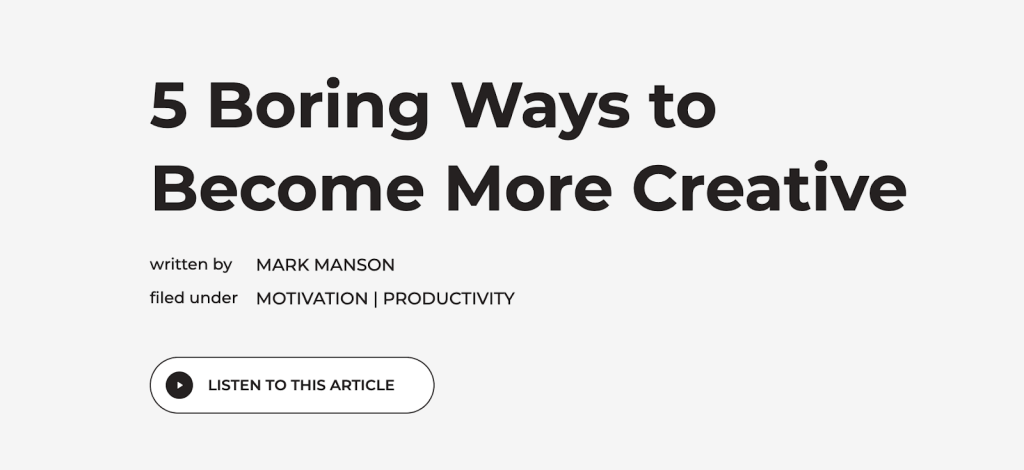
4. Mark Manson’s 5 Boring Ways to Become More Creative
If you’ve ever read Mark Manson, you’ll know he has a nuanced foothold in the self-help industry. And that’s his source of power. While this listicle resembles long-form content, its contrarian tone and in-depth analysis embody the value that his brand offers its audience.
It’s detailed: Each point is broken down with a mini case study, personal anecdotes or psychological evidence, showing why these best practices work. Plus, did you notice how the catchy headline sparks curiosity without screaming clickbait?
Why it works: Using data in a listicle adds authority. Personal anecdotes and valuable insight bring authenticity. This power duo makes your article more credible and relatable.
5. wikiHow’s Cat Sleeping Positions: 22 Common Poses Explained
What kind of listicle article would this be without a nod to the classic wikiHow? While the content doesn’t claim to be at the pinnacle of literary standards, it’s not supposed to be, either. wikiHow is there to give us the information we need, when we need it. And for those of us who need to understand the spiritual or behavioral significance of our cat’s sleeping positions, this listicle delivers succinctly, visually and directly.
Why it works: Combining images and short, easy-to-understand points, the listicle post addresses the audience’s search intent, both engaging and informing readers.
Listicle FAQs
What Is a Listicle?
A listicle is an article structured as a list, presenting information in a series of clearly defined points or sections. Each item typically has a heading and a brief explanation, making it easy to scan and digest.
Are Listicles Good for SEO?
Yes, listicles are excellent for SEO because their structure makes content easy for search engines to crawl and for readers to engage with. Listicles often earn featured snippets and drive traffic due to their clear, organized format.
How Long Should a Listicle Be?
The ideal length depends on the topic, but most effective listicles range from 800 to 2,000 words. The key is to cover your subject thoroughly without adding unnecessary fluff.
Can AI Help Write a Listicle?
Absolutely. AI tools can assist with brainstorming listicle ideas, organizing structure and even generating draft content. However, human input is essential for adding unique insights, brand voice and quality control.
What’s the Difference Between a Listicle and a Regular Blog Post?
A listicle is organized around a numbered or bulleted list, while a regular blog post may use paragraphs, sections or narratives. Listicles are especially useful for topics that benefit from clear, scannable points.
Create Tangible Value With Listicles
There’s no denying it: Listicles are a fantastic format for specific types of information. Want to walk readers through a step-by-step process? Or, how about presenting a range of choices? The clearly defined structure of a listicle facilitates powerful messaging and a deeper connection with your audience. Listicles are:
- Memorable: The structured format helps people retain information.
- Engaging: The listicle holds attention by providing constant breaks for the brain.
- Actionable: Each point gives readers something they can apply or do, making it easier to follow through.
The key is to choose your topics wisely. Don’t force a listicle where it doesn’t fit. Instead, think about when this format will make your content more valuable. When in doubt, go bold — pick subjects and angles that excite you and get creative putting your spin on the listicle format.
Editor’s Note: Updated October 2026.