

There was a time when content marketers could measure success by the size of the crowd. More traffic meant more visibility. More visibility meant more opportunity. And more opportunity — at least in theory — meant more revenue. This equation is breaking down.
In 2026, the relationship between traffic and value is no longer linear. It’s selective, filtered and increasingly shaped by artificial intelligence before a user ever lands on your site. Search engines are now decision engines, not just discovery tools. This shift is forcing marketers to rethink what success actually looks like.
Because when fewer people are clicking, every visit has to matter more.
That’s where revenue per page (RPP) earns its place — not as another metric, but as a reset. It shifts your strategy toward what actually generates results. It’s no longer about doing more, but about understanding what’s already pulling its weight.
Subscribe to
The Content Marketer
Get weekly insights, advice and opinions about all things digital marketing.
Thanks for subscribing! Keep an eye out for a Welcome email from us shortly. If you don’t see it come through, check your spam folder and mark the email as “not spam.”
The Changing Shape of Search: From Crowds to Candidates
To understand why RPP matters, you have to start with what’s happening to search itself.
AI-powered experiences are changing how users interact with information. Instead of scanning multiple results, users are increasingly getting summarized answers directly in search. Top-ranking informational results have seen click-through rates drop by roughly 58% due to AI-generated responses. At the same time, overall search engine volume has declined, with users turning to AI assistants and chat-based interfaces.
On the surface, that sounds like a loss. Less traffic. Fewer clicks. Smaller audiences.
But that’s only half the story. Because AI is refining clicks, not simply reducing them.
AI-assisted search is pushing users toward more task-focused, intentional behavior. People are arriving with clearer goals, fewer distractions and a stronger sense of what they’re looking for.
In other words, the crowd is thinning, but the remaining visitors are far more qualified. This changes how we measure success.
Why Traffic Alone No Longer Tells the Story
For years, traffic has been the headline metric for content performance. It’s easy to track, report and celebrate. But it’s also incomplete.
A page can attract thousands of visitors and contribute very little to revenue. Another can bring in a fraction of that traffic and quietly drive significant business impact. Without a way to connect those dots, it’s difficult to know where to invest your time and resources.
This is the gap RPP fills.
RPP shifts the focus from volume to value. It asks a more meaningful question: not just how many people visited a page, but what those visits were actually worth. In a search environment — where every click is harder to earn — this distinction becomes critical.
What Revenue Per Page Really Measures
At its core, RPP is a measure of efficiency, telling you how effectively a piece of content converts attention into tangible outcomes — whether that’s purchases, leads or pipeline value. It bridges the long-standing divide between content marketing and revenue generation, translating engagement into something the business can directly understand.
The formula itself is simple: Revenue generated by a page, divided by the number of unique visitors it receives over a given period.
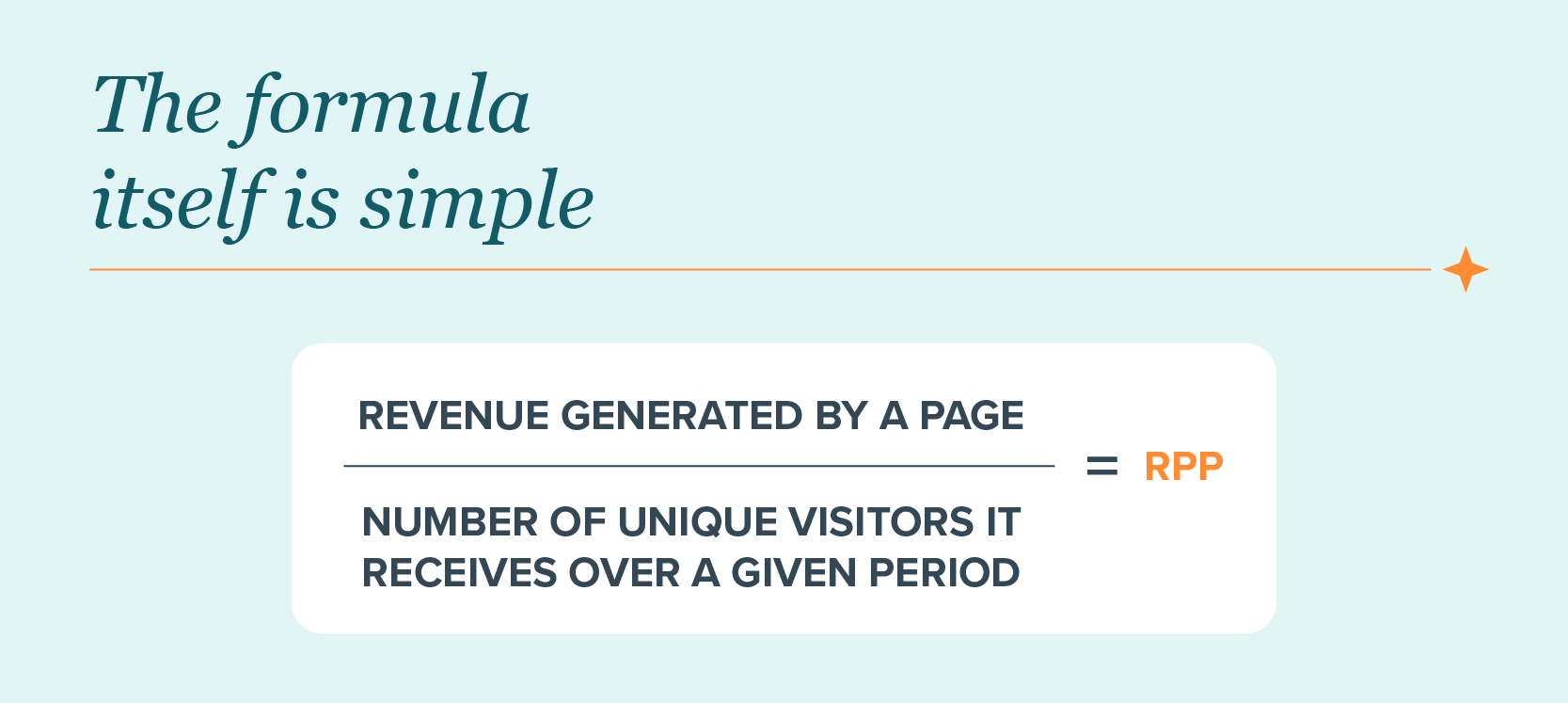
But the simplicity is what makes it powerful.
Imagine a blog post that generates $10,000 in revenue over a month and attracts 2,000 unique visitors. That page has an RPP of $5. Translation: Every visitor who lands on it is, on average, worth five dollars to the business. Now compare that to a page with 10,000 visitors that generates the same amount of revenue. Its RPP drops to $1.
On paper, the second page looks more successful. In reality, the first is doing far more work — RPP makes that difference visible.
A More Honest Way To Evaluate Content
Once you start looking at content through the lens of RPP, patterns begin to emerge. Pages that once looked like top performers based on traffic alone begin revealing themselves as underwhelming contributors to revenue. Others that flew under the radar suddenly stand out as high-impact assets.
RPP has transformed into a diagnostic tool that:
- Highlights where intent and execution align, and where they don’t.
- Surfaces opportunities to improve conversion paths, refine messaging or rethink targeting.
- Clarifies what “quality” actually means for your audience.
In the world of AI Overviews, quality traffic is defined by readiness, not volume.
The Role of AI in Raising the Stakes
AI is reshaping how people search, evaluate and decide. What used to be a linear journey — from query to click to conversion — is now compressed into fewer, more informed interactions. Users arrive with more context, clearer intent and higher expectations from the very first touchpoint.
With tools like Google’s AI-powered search experiences continuing to evolve, users are increasingly presented with synthesized, context-rich answers before they ever click through to a website. By the time they do click, they’ve often already evaluated their options. Each visit becomes more intentional — and more consequential.
There’s also a growing body of evidence that visibility within AI-driven results can amplify performance, with reports suggesting that AI Overviews can drive up to a 35% lift in organic performance and a 91% increase in paid performance. Yet even with those gains, the broader trend is clear: fewer clicks overall, with higher expectations attached to each one.
RPP is what allows you to measure whether you’re meeting those expectations.
When Less Traffic Becomes a Good Thing
One of the most counterintuitive shifts in 2026 is that declining traffic isn’t always a problem.
If your total visits decrease, but your conversions remain stable — or even improve — it’s a sign that your funnel is becoming more efficient. The users who arrive are better aligned with your offering, and your content is doing a stronger job of guiding them toward action. RPP captures that shift in a way traditional metrics can’t.
Instead of flagging a drop in traffic as a negative, it reveals whether the value per visit is increasing. And in many cases, it is.
This is particularly evident in niche or highly targeted content. Pages that address specific, high-intent queries may never generate massive traffic numbers, but they often deliver disproportionate returns. With RPP, those pages finally get the recognition they deserve.
Reframing Content Strategy Around Value
Adopting RPP is reshaping how content is planned, written and optimized over time. Instead of casting a wide net, the emphasis moves toward creating more intentional, purpose-driven experiences.
Keyword strategy becomes more selective, prioritizing relevance and intent over sheer volume. At the same time, content structure begins to work harder, guiding readers toward clear next steps, whether that’s exploring a product, downloading a resource or starting a conversation with sales.
This shift naturally leads to a more iterative, performance-driven workflow. For example, RPP can help you quickly identify where to focus:
- Pages with high RPP that are worth expanding, refreshing or promoting further.
- High-traffic pages with low RPP that may need stronger calls to action or tighter intent alignment.
- Supporting content that could benefit from improved internal linking to high-value pages.
Over time, these insights create a feedback loop where performance data shapes strategy, and strategy becomes more precise with each iteration. Instead of guessing what might work, teams can make informed decisions based on what’s already proving its value.
Transforming Content Into a Revenue Conversation
One of the longstanding challenges in content marketing is proving its impact on revenue in a way that feels direct and defensible. Engagement and traffic metrics offer useful signals, but they don’t always translate cleanly into business outcomes. That disconnect can make it harder to justify investment, prioritize initiatives or align content strategy with broader organizational goals.
RPP helps bridge that gap by connecting individual content assets to measurable financial outcomes.
Instead of evaluating performance in isolation, it reframes each page as a contributor to revenue generation, creating a clearer and more actionable line of sight between marketing activity and business impact. This connection becomes especially valuable when you need to understand what’s actually driving results. RPP can help surface:
- Pages that consistently generate high revenue relative to their traffic.
- Content that attracts strong visibility but underperforms in conversion or revenue contribution.
- Topics or themes that reliably influence downstream pipeline or sales outcomes.
- Pages that may appear low-impact in traditional metrics but deliver outsized financial value.
With this level of visibility, conversations shift. Instead of debating impressions or engagement rates in abstract terms, teams can ground discussions in financial impact.
Over time, RPP evolves into a shared language between marketing, content and revenue teams. It helps align stakeholders around what “performance” actually means in practice, not just in theory. Strategy discussions become more focused on outcomes, and content planning is more closely connected to business goals.
In this way, RPP functions less like a dashboard stat and more like a decision-making framework to identify where content is creating value and where it needs to be rethought.
The Bigger Picture: A Shift Toward Efficiency
RPP is ultimately reflecting a broader shift in how digital performance is evaluated. As AI continues to reshape search, efficiency is becoming more important than scale. Today, you not only have to attract attention, but you also have to make that attention count.
This doesn’t mean traffic is irrelevant. It still plays a critical role in building awareness and feeding the top of the funnel. But it does mean that traffic alone is no longer a reliable indicator of success — value is.
In this context, value is best understood on a per-page basis.
Following the Trail Forward
If search in 2026 feels less predictable than it once did, that’s because it is. The paths users take are changing, the signals we rely on are evolving and the metrics that once defined success are being reexamined.
RPP offers a way to navigate that uncertainty with greater clarity. While it doesn’t replace other metrics, it does reframe them and shifts the focus from how much you’re attracting to how well you’re converting. This realigns content performance with the outcomes that matter most to the business.
In a world where every click feels harder-won and more deliberate, that alignment stops being a nice-to-have and becomes the difference between noise and impact. Because the point isn’t to simply get people through the door; it’s to get them to do what you want once they arrive.