

How can you make sure everyone in your organization is on the same page when it comes to your brand? By hosting branding exercises, of course!
Whether you opt for a rapid-fire brand sprint that fits into a single afternoon or a multi-day branding workshop packed with collaborative exercises, these activities ensure that every stakeholder speaks with one consistent voice. If you’re unsure of which activities can best support your team, our guide will help.
The Value of Branding Exercises
It’s essential thateveryonein your company — from the CEO to the intern — has a clear understanding of your corporate branding and the overarching marketing strategy it embodies. A shared understanding of your tone of voice, positioning statement and brand mission values makes day-to-day decision-making faster and more confident.
Strong branding brings benefits to businesses both big and small. It drives marketing campaigns, improves brand awareness and attracts more customers to your organization. Internally, your brand personality creates the foundation of your company culture, shaping everything from user experience design to employee engagement. And through branding exercises, your team will learn how to incorporate your brand values into their daily work and customer interactions.
Essentially, you want to create a complete brand experience when consumers interact with your business. To achieve that goal, your branding must remain consistent throughout every customer touchpoint. Therefore, making branding exercises a part of your employee training and development is key. Every effective brand exercise makes it easier to communicate brand values clearly and consistently so your marketing, sales and support teams can deliver a seamless experience.
How Can You Incorporate Branding Exercises Into Your Department?
First things first, what are branding exercises, exactly? These are activities that you can complete with specific departments or individual team members that support increased brand knowledge and familiarity. Think of them as structured workshop exercises that translate intangible concepts like purpose and personality into practical talking points, visual cues and processes.
Branding exercises can happen during new employee onboarding, but you should also implement them as training sessions throughout the year. A quarterly brand workshop, for example, can realign fast-growing teams and ensure your brand guide remains top of mind. These events can range from silly to serious. But no matter the tone, your team should walk away feeling like they learned something valuable.
Of course, you’ll need to tailor your branding exercises to fit the staff you’re training. For example, your sales team spends the most time speaking to customers, so their exercises should focus on creating conversations that align with your brand strategy and help them answer questions with confidence. Likewise, a product or UX group might need a session that connects brand design elements to practical user experience standards.
Branding Exercises for Brainstorming Your Organization’s Key Attributes
Brand attributes are the core values and characteristics that make up your brand identity. You can think of the attributes as personality traits. For example, is your branding technical, or do you adapt a witty tone in your marketing messages? Most importantly, these attributes become branding tools you can use to market your business and build long-term brand loyalty.
To help your team gain a clear understanding of the qualities that make up your brand personality, try performing these branding exercises:
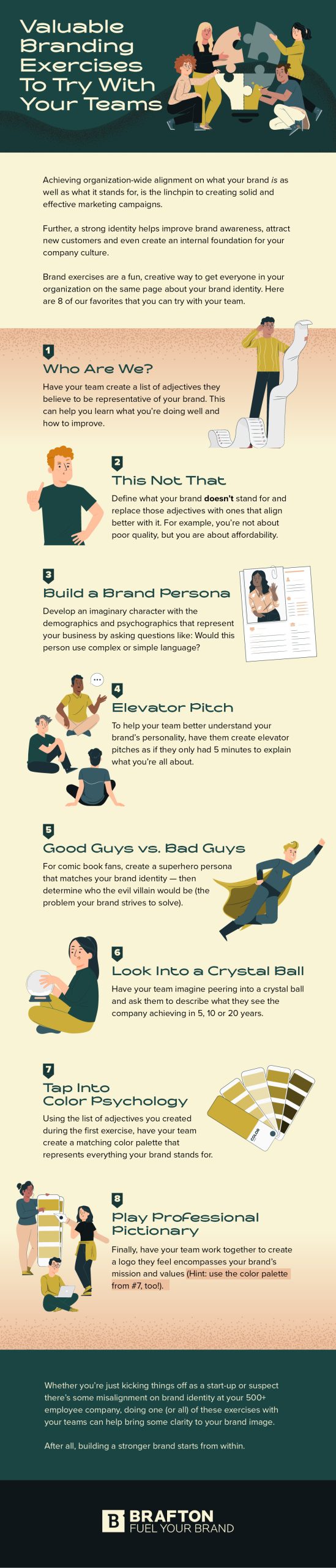
1. Who Are We?
For this activity, have your team create a list of adjectives that describe your brand. Equip every participant with a stack of colourful sticky notes, then ask them to jot down descriptors rapid-fire. Start with what your employees think your brand represents. Then, review that list and determine whether they left out any key adjectives. Afterward, make sure everyone involved has a copy of the completed list (or paste it into a shared brand guide!) so they can reference it as needed.
Variation: The Four Keyword Method
Ask your team to distill your brand down to just four keywords. These should be the four most crucial values, traits or differentiators that define your brand identity. Writing each keyword on separate sticky notes and grouping similar ideas is a tactile way to visualize what truly matters.
2. This Not That
With this activity, you define what your brand doesn’t stand for. Create a list that includes adjectives that don’t resonate with your brand positioning or company culture. Then, identify more relevant words to replace these adjectives. Here are a few examples to get you started:
- Our brand is straightforward but not monotone.
- Our branding strives to be honest but not informal.
- Our brand prioritizes affordability but not poor quality.
This exercise is crucial in establishing a strong brand identity that clearly differentiates your business from competitors, especially if you’re trying to stand out in a saturated market. It also helps define values that guide future decision-making when you create brand collateral or launch new content marketing campaigns.
3. Build a Brand Persona
If your team has trouble identifying your brand’s attributes, viewing your brand as a person can help. This exercise builds a brand persona by developing an imaginary character with the demographics and psychographics that represent your business.
To start, have everyone picture your brand as a person. Then ask questions, such as:
- What type of colors would this person like?
- Would this person use complex or simple language?
- If this person was a fictional character, who would they be?
- How would this person respond to certain challenges?
- How do others — like our customers — describe this person?
Creating a brand persona can offer valuable insights into how your brand should communicate on social media, embodying a tone of voice that resonates with your audience. Over time, you can weave these insights into your brand workshop exercises, ensuring every department understands how to speak and behave like your brand persona.
Variation: Personality Summary Challenge
For this activity, challenge team members to describe your brand as if it were a person, but with a twist: They must do so in a single sentence or short paragraph. Then, compare responses and discuss any similarities or differences. Repeating the challenge during subsequent brand workshops will reveal how perceptions evolve as you build brand equity.
Branding Exercises for Emphasizing Brand Value
Efficient branding does more than talk the talk — it also emphasizes the value that a business can provide its customer base. And with these branding exercises, you can help your team understand the problems your target demographic faces, how your organization solves them and how your business differentiates itself from competitors:
4. Elevator Pitch
Everyone should have an elevator pitch that briefly describes who they are, gets one or two main points across and helps them connect with other professionals. To help your team form a better understanding of your brand’s personality, have them create elevator pitches for your brand.
Pretend there are only five minutes to explain your brand to a potential customer:
- What keywords should you use to describe the company?
- What points do you want to get across?
- How would you form a connection with the person listening?
After creating the pitches, have everyone practice stating it to others in the group. This activity not only reinforces the brand story but also prepares your team to serve as brand ambassadors in any setting. It’s a quick exercise that solidifies a concise positioning statement and directly supports sales enablement.
5. Good Guys vs. Bad Guys
If you’re working with a particularly creative group, then this branding exercise is perfect. Instead of picturing your brand as a business, have your team imagine it as a superhero.
First, create a superhero persona that matches your brand identity. Then determine who the evil villain would be.
Keep in mind that the bad guys aren’t necessarily other businesses or competitors. Rather, the villain is the problem that your brand strives to resolve. And if your brand solves a variety of problems, then you’ll need to create a rogue’s gallery of villains that need defeating. Mapping these foes to your competitive landscape clarifies where your solutions shine brightest.
6. Look Into a Crystal Ball
Keeping on the theme of creativity, use this branding exercise to harness your inner psychic. Have your team imagine they’re peering into a crystal ball. Ask them to describe what they would see the company achieving in 5, 10 or 20 years. Not only will this exercise help your team reflect on what your brand currently stands for, but it can also prompt discussions about your brand’s values and mission. As a leader, you can use this feedback to develop a long-term brand strategy that aligns with wider business strategy and future market opportunities.
7. The Pixar Pitch
The Pixar Pitch is a storytelling framework inspired by the way Pixar crafts its movies. In this branding workshop exercise, have your team tell your brand’s story using this formula:
- Once upon a time …
- Every day …
- One day …
- Because of that …
- Because of that …
- Until finally …
This narrative structure encourages teams to think sequentially, ensuring every chapter of your brand story answers audience questions. The exercise helps communicate brand purpose and values in a memorable, emotionally resonant way that supports content marketing and campaign planning.
Branding Exercises for Channeling Your Inner Designer
Branding isn’t just something you convey through messaging and marketing campaigns — it’s also visual. The way you design and present your assets can strengthen user trust, improve user experience and create brand recognition at a glance.
The visual components that make up your brand identity include your:
- Logo.
- Brand colors.
- Fonts and typography.
- Imagery, photographs and videos.
These exercises can help your team understand the visual elements of your brand and how certain styles send a message to your target audience, ensuring every design choice aligns with overall brand design guidelines and supports the brand mission values you’ve established:
7. Tap Into Color Psychology
Color psychology refers to the idea that different colors impact mood and influence behaviors. For example, the color red may be stimulating, while blue is perceived as soothing.
This branding exercise uses color psychology to create a visual identity for your brand. You can use the list of adjectives you created during the “Who Are We?” activity to define the brand personality traits that apply to your organization. From there, your team can create a color palette that represents everything your brand stands for and the responses it seeks to encourage. Document the final palette in your brand guide so designers, copywriters and any external workshop facilitator can reference it when they create brand assets.
8. Play Professional Pictionary
For this exercise, have your team work together to create a logo that they feel encompasses your brand’s mission and values. And if you want to build on prior exercises, have them incorporate the color palette created during the color psychology exercise.
After the creations are complete, the groups can present their logos. Gather feedback from the crowd and see if other staff members can describe the brand values presented in the logo designs. This is an excellent opportunity for a graphic designer in your team to provide professional insight and perhaps lead a mini-branding workshop on effective logo design. Recording the discussion and pinning the sketches to a virtual whiteboard of sticky notes can spark further workshop exercises about typography, iconography and layout conventions that reinforce user experience best practices.
More Inspo for Branding Exercises
The takeaway is simple: Building a stronger brand starts from within, which is where branding exercises come into play. By routinely engaging your team in brand workshop exercises — from rapid brand sprints to in-depth workshops — you create an environment where every exercise helps understand and reinforce who you are and why you matter. Remember, a successful branding workshop involves active participation from all participants, ensuring every individual contributes to shaping a strong brand identity.
Editor’s Note: Updated April 2026.