For some modern marketers, content marketing return on investment isn’t a question of if, but when.
After all, data shows that:
- Content marketing costs 62 percent less than traditional marketing yet provides three times as many leads.
- Conversion rates are six times higher for content marketing adopters.
- 82 percent of marketers see positive ROI from blogging.
Unfortunately, the simple act of using content marketing is no guarantee of success. Every content marketing strategy depends on numerous components, making it difficult to answer the question on the tips of everyone’s tongues: How long does it take to see digital marketing ROI?
In order to maximize ROI and see results quickly, you must first understand all the elements at play, as well as how they may impact the time it takes for your content marketing strategy to pay off.
Measuring ROI
Before you can prove the effectiveness of your content marketing efforts, you must know what effectiveness looks like.
We’ve written before about the importance of focusing on metrics that impact your bottom line, as opposed to vanity metrics. In general, you’ll want to put lead generation and conversions at the top of your list. However, drawing a straight line from a blog post to a sale is easier said than done.
“Some things are an indicator of ROI, but not a sale themselves,” said Will Stevens, Director of Content Marketing at Brafton. “If the expectation is, in a quarter, show me the money generated by blogs, you can use an attribution model. But it’s difficult to measure how a blog post may have influenced someone to ultimately outfit their entire business with your product or service.”
Additionally, while your bottom line should always be top of mind, sometimes sales aren’t the singular goal of content marketing campaigns. If you’re focused on brand awareness and thought leadership, lead generation and conversions won’t necessarily be the most important metrics to examine. You’ll want to analyze website traffic, session lengths, bounce rates, social media engagement and other appropriate indicators.

The elements of ROI
Still, the question remains: How long will it take to see results?
First consider the planning that goes into a quality content marketing strategy. You must determine what you’ll produce and in what formats, from blog posts and white papers to eBooks and infographics. Your content marketing plan is arguably the most difficult part of the process. You need to carefully consider how you are going to create content that addresses audiences at each stage of the funnel (strategy), how you will entice a visitor to engage with that content (UX), and how you will launch your campaigns (promotion and execution). Creating the content is the easiest part, believe it or not.
After production, you must distribute the content across the appropriate channels, including your on website, over email and on various social media networks.
“Assuming you’re following best practices, by month six you should see that your blog is generating a lot of search traffic and impressions,” said Jeff Baker, Director of Digital Marketing Strategy at Brafton.
If you’re tracking lead generation and conversions, search traffic and impressions won’t exactly send you shooting through the roof. However, keep in mind that blog posts are top-of-sales-funnel content assets, intended to help push prospective customers down the funnel. Whether your efforts succeed depends on multiple factors, including:
- Producing content tailored to detailed buyer personas.
- Ensuring content is authoritative and serves searcher intent.
- Creating different content types, such as blog posts, case studies and success stories.
- Implementing user experience best practices to guide visitors.
- Incorporating visual calls to action and making funnel-appropriate content assets available as next steps.
Of course, blogs are only one example.
“It completely depends on the intent and the channel you’re using,” Jeff said. “If you’re launching a campaign that is heavily buyer-intent targeted, such as a pay-per-click e-commerce campaign, your goal is to get people to buy this very second. You’re not using PPC for thought leadership or awareness, you’re doing it to convert leads and sell products.”
However, this type of strategy also takes time.
“If your product is Christmas trees, don’t expect ROI in July.”
“It usually takes three months,” Jeff said. “The first month is you getting a feel for the keywords you’re using. The second month is refining your strategy. The third month is seeing ROI. And that is for a very transactional-focused campaign.”
Also remember that nothing exists in a vacuum, especially your content marketing strategy.
“The time of year will completely impact how long it takes to see ROI,” Will said. “Economies and markets are cyclical. There are buying times, times when budgets are allocated, times when consumers don’t spend anything. There are times when your customers will hunker down and look at numbers before making a decision.”
If you operate in an industry that follows a particularly cyclical nature, it’s vital to launch campaigns at the appropriate times to see ROI.
“If your product is Christmas trees, don’t expect ROI in July,” Will said.
Organic vs. paid ROI
Paid content marketing campaigns can provide substantial ROI faster than organic options. However, as the name implies, all those PPC pushes and targeted ads on social networks will cost you. This means you should make paid ROI analysis a priority.
“When it comes to measuring ROI, you need to be measuring your paid efforts immediately,” Jeff said. “You’re paying for results, and your ROI should match how much you’re spending and how long you’re doing it.”
While organic content marketing efforts don’t typically provide the immediate feedback of paid campaigns, they’re more cost-effective and can be used for goals beyond closing deals.
The important thing is understanding that both options have their place in your content marketing strategy.
While it may be tempting to focus solely on paid campaigns for rapid returns, keep in mind that the sales funnel includes consumers at all stages, not just those ready to sign on the dotted line.
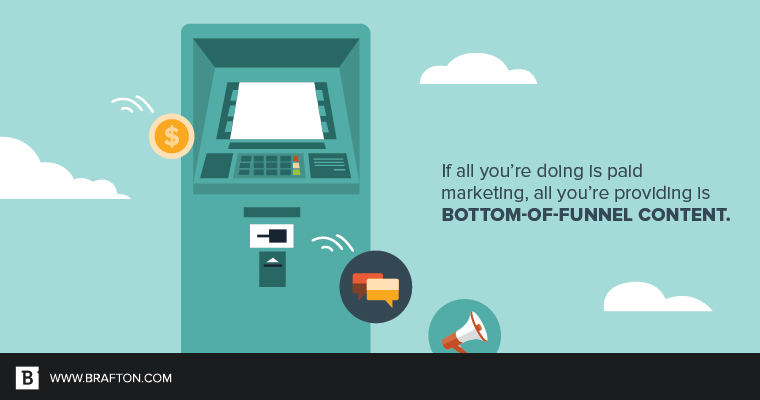
“If all you’re doing is paid marketing, all you’re providing is bottom-of-funnel content,” Jeff said. “You need a well-rounded strategy. Imagine landing on a website and all it says is ‘buy now’ or ‘buy this’ or ‘buy here.’ You need to tell a story about your brand. You need to provide an experience for visitors. If you don’t, there’s a good likelihood people are going to turn away.”
And don’t forget you’re not alone in trying to reach prospective buyers.
“What are your customers doing when they’re not buying?” Will asked. “They’re researching. They’re looking for answers to their questions. If you’re not ranking organically, and your competitor is, and your competitor has valuable content, then they’re nurturing your customers and taking them from you.”
Solid numbers should be the basis of your ROI. That said, it takes time, and not everything is a hard sale.